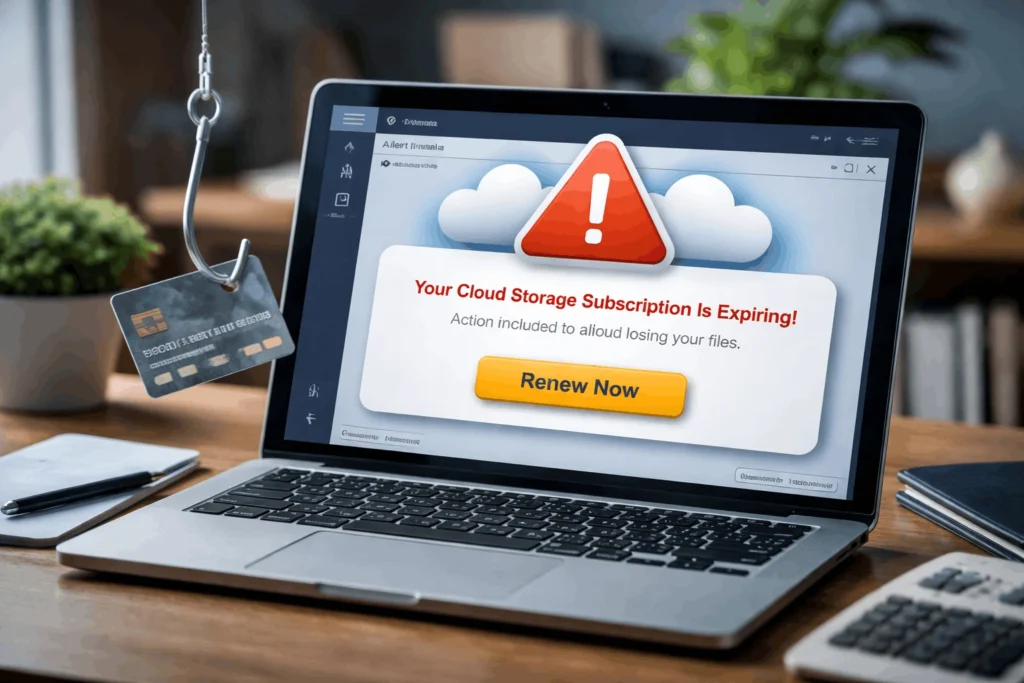
Inbox phishing has entered a new phase as a widespread cloud storage payment scam targets users with urgent fake renewal notices. The messages claim storage plans have expired or payments failed, warning that files could soon be deleted. By exploiting fear around lost photos, backups, and documents, attackers pressure recipients into acting quickly and without verification.
The campaign stands out due to its scale, polish, and use of trusted cloud infrastructure to disguise malicious redirects. As cloud storage becomes central to daily life, these scams increasingly blur the line between legitimate billing notices and fraud.
How the Cloud Storage Payment Scam Works
The scam begins with emails designed to resemble official billing or renewal notifications. They warn recipients that their cloud storage account has reached its limit or that a payment failed. The language stresses urgency, often suggesting imminent data loss if no action is taken.
Each email includes a button or link encouraging users to renew or upgrade their storage plan. These links frequently route through legitimate cloud-hosted redirect services before landing on fraudulent websites. That extra step helps the emails bypass security filters and appear more trustworthy to recipients.
Once on the fake page, victims see warnings about full storage and limited-time discounts. The site mimics real cloud dashboards, complete with progress bars and storage usage graphics. Any attempt to “fix” the issue leads to payment forms or credential requests controlled by the attackers.
Why These Fake Renewal Emails Look So Convincing
Attackers invest heavily in realism. The emails often include personalized details such as account IDs, expiration dates, or service names commonly associated with popular cloud platforms. This personalization lowers suspicion and increases the chance of engagement.
The landing pages reinforce the illusion by copying visual elements from legitimate services. Fonts, layouts, and terminology closely match real dashboards, making it difficult for less technical users to spot inconsistencies. Combined with urgent messaging, this design pushes users to act before thinking critically.
By hosting parts of the scam infrastructure on trusted cloud services, attackers further reduce red flags. Many recipients see familiar domains in previews and assume the message is legitimate.
What Cybercriminals Gain From the Scam
The primary goal is payment fraud. Victims who enter credit card details unknowingly send their information directly to criminals. Some pages also collect personal data, which can later be reused for identity theft or sold on underground markets.
In other cases, the scam redirects users to affiliate offers disguised as upgrades. These schemes generate revenue for attackers even when no payment information is stolen. The victim still receives nothing in return, while believing the storage issue has been resolved.
Stolen login credentials can also enable follow-up attacks. Compromised accounts may be used for further phishing, data theft, or account takeover attempts.
Warning Signs Users Should Not Ignore
Urgent language threatening immediate data deletion is a key indicator of fraud. Legitimate providers rarely demand instant action through email links. Another red flag is unexpected payment failure notices, especially when no billing issue exists.
Links that redirect multiple times before reaching a final page deserve extra scrutiny. Requests for full payment details without requiring normal account authentication should also raise concern. Even polished emails can be malicious when pressure replaces transparency.
How to Stay Protected From Fake Cloud Billing Emails
Users should avoid clicking links in unexpected storage or billing emails. Instead, they should check account status directly through official apps or bookmarked websites. This simple habit eliminates most phishing risks.
Email filtering tools should remain enabled, and suspicious messages should be reported rather than ignored. Awareness training also helps organizations reduce the success rate of these scams, especially for non-technical users who rely heavily on cloud services.
Final Thoughts
The cloud storage payment scam highlights how phishing continues to evolve alongside everyday technology. By exploiting trust in cloud platforms and fear of data loss, attackers achieve high engagement with minimal effort. Awareness, verification, and cautious habits remain the most effective defenses against these increasingly polished email scams.
