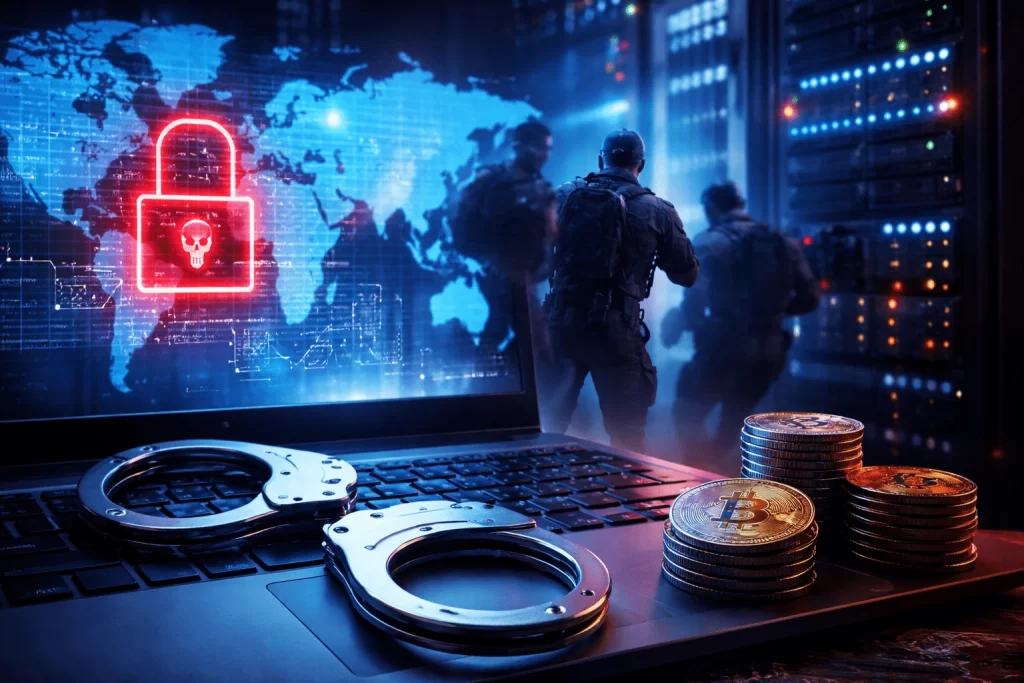
An unprecedented Interpol ransomware crackdown has delivered a major blow to global cybercrime operations. Coordinated across dozens of countries, the operation led to hundreds of arrests, the dismantling of criminal infrastructure, and the successful decryption of multiple ransomware strains. The effort highlights how international cooperation has become a central weapon against ransomware threats that increasingly target governments, healthcare providers, and critical industries.
Rather than focusing on a single group, authorities targeted the broader ecosystem that enables ransomware attacks to operate at scale.
A Coordinated Global Law Enforcement Effort
Interpol coordinated the operation alongside national police forces, cybercrime units, and judicial authorities. Investigators worked across jurisdictions to share intelligence, analyze seized systems, and identify suspects involved in ransomware deployment and financial operations.
The scale of coordination marked a shift in enforcement strategy. Law enforcement agencies pooled resources instead of acting independently, accelerating investigations and expanding their reach beyond national borders.
This collaborative model allowed authorities to act quickly once critical infrastructure was identified.
Six Ransomware Strains Decrypted
One of the most significant outcomes of the Interpol ransomware crackdown involved the decryption of six ransomware strains. Investigators gained access to encryption keys after seizing servers, backend systems, and command infrastructure used by criminal groups.
These decryptions allowed affected organizations to recover encrypted files without paying ransoms. In many cases, victims had limited recovery options before law enforcement intervention.
Decrypting active ransomware strains weakens criminal leverage and undermines the profitability of extortion campaigns. It also discourages future victims from paying, knowing that recovery may still be possible.
Hundreds of Arrests Across Multiple Regions
Authorities confirmed hundreds of arrests linked to ransomware operations. Those detained included individuals responsible for developing malware, brokering initial system access, laundering ransom payments, and maintaining technical infrastructure.
Investigations also uncovered supporting networks that helped ransomware groups operate quietly. These networks often include money mules, hosting providers, and intermediaries that mask criminal activity.
By targeting these supporting roles, law enforcement disrupted the entire ransomware supply chain instead of only pursuing headline operators.
Infrastructure Seizures and Financial Disruption
The operation extended beyond arrests. Law enforcement agencies seized servers, shut down command-and-control systems, and disrupted illicit payment channels used to collect ransom funds.
Authorities also identified cryptocurrency wallets linked to extortion campaigns. This financial intelligence provides investigators with long-term visibility into ransomware operations and future opportunities for enforcement action.
Disrupting infrastructure forces criminal groups to rebuild, increasing operational risk and reducing trust within their networks.
Why This Crackdown Matters
The Interpol ransomware crackdown reflects a broader evolution in how cybercrime is policed. Law enforcement now treats ransomware as an organized criminal industry rather than isolated hacking incidents.
Key impacts include:
- Reduced financial incentives for ransomware operators
- Increased arrest risk across multiple jurisdictions
- Faster victim recovery through decryption efforts
The operation also demonstrates that even highly distributed cybercrime networks leave digital and financial trails that investigators can exploit.
Ransomware Threats Will Continue
Despite its scale, the crackdown does not eliminate ransomware entirely. New malware variants will appear, and criminal groups will adapt their tactics to evade detection.
However, sustained international cooperation raises costs for attackers. Each disruption limits their ability to operate efficiently and increases the chance of exposure.
Ransomware groups must now assume that infrastructure seizures and decryptions are real risks.
Final Thoughts
The Interpol ransomware crackdown stands as one of the most impactful global cybercrime enforcement efforts to date. By combining arrests, infrastructure takedowns, and ransomware decryption, authorities delivered measurable harm to criminal operations.
While ransomware remains a persistent threat, this operation shows that coordinated law enforcement action can significantly weaken even the most sophisticated cybercrime networks.
