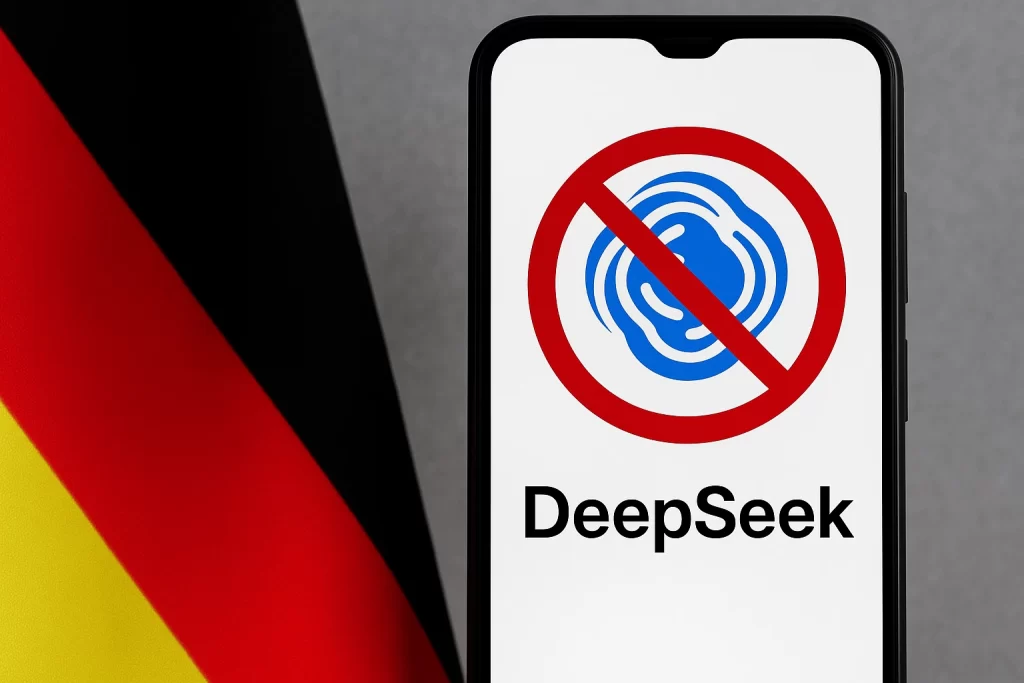
Germany is taking decisive action against Chinese AI chatbot DeepSeek, calling for its ban from app stores due to serious privacy concerns. Authorities accuse the app of illegally transferring user data to China. Thus, violating both EU privacy laws and fundamental security expectations.
German Regulator Demands App Removal
On June 27, 2025, Berlin’s Data Protection Commissioner Meike Kamp officially requested that Apple and Google delist DeepSeek from their German app stores. The watchdog cited violations of the EU’s General Data Protection Regulation (GDPR). Particularly Article 46(1), which mandates strict safeguards for transferring user data to non-EU countries.
Kamp warned that DeepSeek offers no evidence of protecting EU citizens’ personal data from access by Chinese authorities. This makes its operations incompatible with EU law. In a rare move, she also reported the app under Article 16 of the EU’s Digital Services Act, labeling its presence in app stores as “illegal content.”
Not Just a German Issue
Germany is far from the first country to act. Italy banned DeepSeek in January 2025, becoming the first EU state to block the app over privacy violations. Since then, France, the Netherlands, Luxembourg, Portugal, and the Czech Republic have all launched their own investigations or imposed limited bans, especially on government networks.
Globally, nations like Australia, Taiwan, South Korea, and the United States have also flagged or restricted the app. Largely due to fears that sensitive data could be accessed by Chinese government entities under local law.
Why DeepSeek Is Under Fire
DeepSeek has faced mounting scrutiny for its opaque data handling practices. The app collects a wide range of personal data, including chat logs, keystrokes, IP addresses, and device identifiers. Critics argue that this data is vulnerable to interception or misuse, particularly since DeepSeek is based in China, where government access to corporate data is legally mandated.
No adequate safeguards appear to be in place to ensure that user data from the EU is protected once transferred overseas. Unlike countries deemed “adequate” under GDPR (like Japan or the UK), China lacks a formal agreement or legal framework to guarantee data protection parity with the EU.
What Happens Next?
At the time of writing, Apple and Google have not publicly responded to Germany’s takedown request. If they comply, DeepSeek will likely be removed from their German app stores, cutting off new downloads for most users. Those already using the app may still access it through VPNs or sideloading, but that comes with added risks and technical barriers.
If Germany proceeds with enforcement, other EU countries may quickly follow. A coordinated EU-wide ban could be on the horizon—especially if the European Commission weighs in.
Final Thoughts
The DeepSeek ban in Germany signals a growing European crackdown on apps that fail to meet strict data protection standards. As more countries scrutinize how AI platforms handle personal data, tech companies and users alike will need to reckon with the complex intersection of innovation, privacy, and geopolitics.
