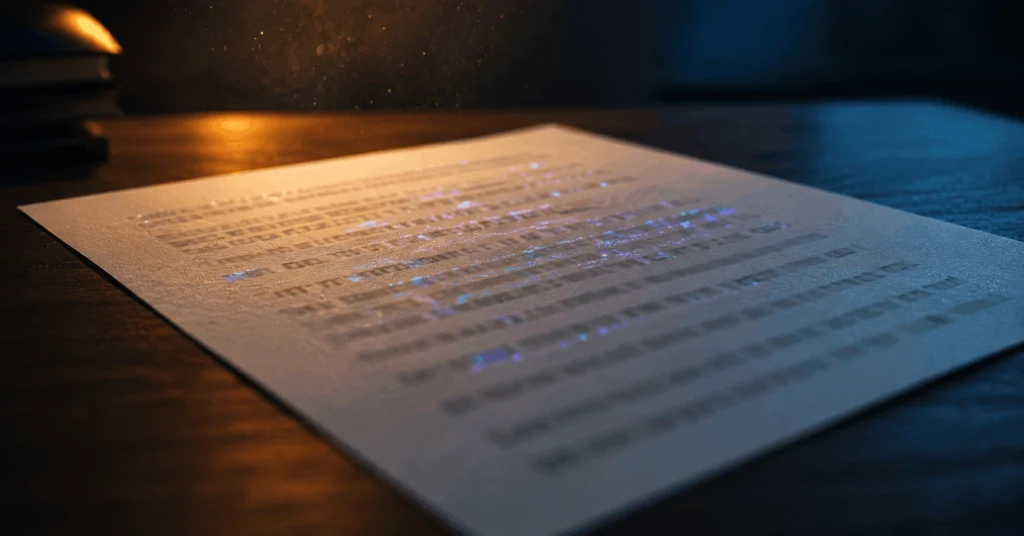
Anthropic has revealed how it plans to mark the text Claude produces, and the method avoids the usual tricks. Claude AI watermarking runs during generation rather than after it, so nothing attaches to the finished response. The technique draws on Google DeepMind’s SynthID-Text research, and it leaves a statistical trail instead of a visible one.
This matters because machine-written text now fills inboxes, product reviews, job applications, and scam messages. Readers want a reliable way to separate human writing from model output. But detection tools have stayed unreliable, so a signal that lives inside generation itself marks a real shift.
How Claude AI watermarking changes the model’s word choices
Language models write one token at a time. At each step, several words could fit the sentence equally well. A random number generator normally settles the choice. Claude AI watermarking replaces that generator with something more structured.
A secret key, combined with a handful of words that came just before, now guides the pick instead of an arbitrary number. The result still looks random to a reader. However, the pattern behind it follows a rule that only a key holder can verify.
Those tiny decisions repeat hundreds of times across a long passage. A detector holding the key compares the sequence against the choices Claude would have made. From there, it estimates the probability that Claude helped write the text. The check also runs without access to the model itself, which keeps it cheap and fast.
The output stays untouched
The company stresses that no hidden characters appear anywhere in the output. Watermarking consumes no extra tokens either, so users pay nothing more for it. Generation speed takes only a negligible hit.
Internal testing also found no effect on creativity, readability, or the substance of Claude’s answers. Earlier approaches often degraded output quality, which makes this a meaningful bar for Claude AI watermarking to clear. Here, the model still picks freely, just from a pool of randomness with a different seed.
Where Claude AI watermarking steps aside
Exact answers and working code
Some outputs allow only one correct choice. For example, after the model writes “2 + 2 =”, nothing beats “4” as the next token. The watermark leaves those moments alone, because a nudge there would produce a wrong answer.
Code follows the same logic. Swapping one variable name or function for a synonym could break a program outright. So code carries far less Claude AI watermarking than ordinary prose. Comments and other free-form sections can still hold the signal.
Edits, proofreading, and translations
Light proofreading of human writing rarely leaves enough model-chosen words behind. A few grammar fixes give the detector almost nothing to measure, so Claude AI watermarking fades in lightly touched documents. Translation works differently, because Claude selects every word in the translated version. Those outputs carry a full watermark.
A detection API is coming, but proof is another matter
Anthropic plans to release an API that checks text for Claude AI watermarking. The tool will estimate how likely Claude was involved in a piece of writing. Still, likelihood and authorship are not the same thing.
The system cannot separate “Claude wrote this” from “Claude heavily edited this.” It also cannot flag text from other AI models, since rival systems use their own keys and methods. Short samples weaken the result further, because fewer word choices exist to analyze.
Anyone determined to strip the mark can do so. A complete rewrite that replaces every word removes it. Light editing, though, probably leaves the pattern intact. That gap explains why watermarking works better as a broad signal than as a courtroom exhibit.
Images get signed metadata instead
Image files in PNG, JPG, and SVG formats follow a separate route. Claude attaches C2PA provenance metadata with a cryptographic signature. That metadata records that the file passed through Claude, without altering the image itself.
Metadata travels less reliably than an embedded pattern, of course. Screenshots, re-encoding, and many social platforms strip it during upload. So provenance data helps most when files move through channels that preserve it. Text watermarking avoids that fragility, because the pattern lives inside the words themselves.
What Claude AI watermarking means for your online security
Provenance tools serve a real defensive purpose. Fraud teams, newsrooms, and moderators need better ways to trace synthetic content. AI-written phishing emails already slip past filters that expect clumsy human scams. Those messages read cleanly now, so old warning signs like broken grammar no longer help.
Yet detection sits at the very end of the chain. A watermark cannot stop a scam message from reaching you. It cannot hide your browsing habits from data brokers either. Those problems need protection further upstream.
A VPN encrypts your traffic and masks your IP address from the networks you do not control, which cuts off one common source of profiling data. That reduces the personal detail available for building targeted lures in the first place. Pair that habit with strong passwords, multi-factor authentication, and healthy suspicion toward urgent messages. Together, these layers protect far more than any single detection tool.
Final Thoughts
Claude AI watermarking marks a serious attempt at content provenance, and the engineering behind it looks careful. The system adds nothing visible, costs nothing extra, and steps back where accuracy demands it. Those tradeoffs make adoption realistic rather than symbolic.
But the limits deserve equal attention. Statistical likelihood will never equal proof, and a determined bad actor can rewrite their way past the mark. Treat detection as one signal among many. Your own habits and tools still carry most of the weight.
