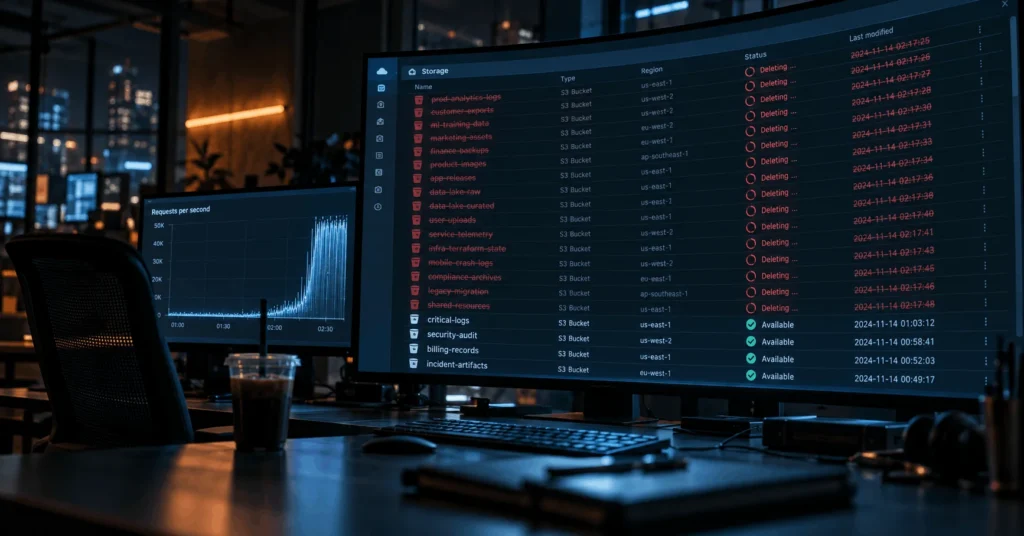
Seven minutes was all it took to wipe more than 100 storage accounts from a single Microsoft Azure tenant. No human sat at the keyboard, because AI agents did the scouting, stole the keys, and started deleting on their own. Microsoft researchers have tied two of these break-ins to the JadePuffer ransomware operation.
The ending everyone expects from a ransomware story never arrived here. No ransom note turned up, nobody opened negotiations, and researchers found no sign that data left the tenant. The attackers broke things, then stripped the backup safeguards so rebuilding would hurt.
A Seven-Minute Demolition Job
Microsoft spotted the activity in June, when an AI agent mapped everything inside the hacked tenant. It pulled storage account keys one by one, then began deleting. Its target list ran past 100 Azure Storage accounts, plus Key Vaults, Function Apps, Virtual Machines, and App Services.
The destructive stage lasted about seven minutes, which leaves no real window for an analyst to step in. Older ransomware crews crept through a network for days first, which gave defenders room. The JadePuffer ransomware campaign squeezes the same job into a coffee break.
Half an hour after the wipe, the operators returned and fired off more than 30 requests for storage account keys. Most of those requests worked. Access stayed live long after the first alarm should have sounded.
How the JadePuffer Ransomware Operators Got Inside
The entry point had nothing to do with phishing or an unpatched server. Both attacks ran through hijacked service principals, the machine identities that let software sign in to Azure and reach the resources an admin assigns them. The attackers abused two of them, and both sat in the same tenant.
Those two service principals split the job, with one handling discovery while the other took care of destruction and credential theft. Microsoft could not pin down how the attackers got those credentials. Details for one had turned up in a public GitHub issue before the attacks, though.
That last detail matters for anyone who runs cloud systems. Secrets leak into public repositories all the time, often through a pasted config file or an old debug thread nobody cleaned up. Scanners find them fast. The JadePuffer ransomware crew appears to have gained from exactly that kind of slip.
Why Machine Identities Slip Through the Cracks
Service principals behave nothing like the accounts your staff use. Nobody signs into them each morning, and they rarely sit behind a second login check. They exist so software can talk to software, which means they run quietly with more rights than the job needs.
A stolen machine identity can therefore stay useful for months, long after anyone would have rotated a human password. Security teams watch employee logins closely, yet the machine accounts underneath get far less scrutiny. JadePuffer ransomware agents worked that blind spot hard.
Where the Attack Broke Down
Not everything went the attackers’ way, and the failures matter most here. Several storage accounts survived because Azure resource locks and account-level guards blocked the delete requests outright. Attempts to strip out the recovery locks failed as well.
The agent also fumbled its run at Azure SQL, and that failure exposed the limits of running an attack on autopilot. It called an unsupported API version, so those deletions collapsed. Hitting SQL and storage at once points to a push for the widest possible damage.
Before the deletions, the operators removed Azure Site Recovery locks, which exist to stop anyone erasing backups. That move matches a pattern across modern extortion cases. Killing the recovery path matters as much as killing the data, since clean backups leave nothing to negotiate.
Why This Matters Beyond the Enterprise
Most people never touch an Azure tenant, yet an attack like this still reaches them. Business cloud platforms hold customer records, medical files, payroll data, and backups for millions. When a JadePuffer ransomware attack wipes storage at that scale, everyone whose data sat inside loses access with it.
A broader shift in attacker tooling sits behind all of this. AI agents lower the skill floor, so work that once needed a practiced team now goes to software. The JadePuffer ransomware model already runs at production scale, and copycats will follow.
For regular users, the answer sits in basic account hygiene. Strong unique passwords help, two-step login helps more, and your own backups cover the rest. A VPN protects your connection on public networks, though it cannot help once an attacker holds valid credentials.
Hardening Cloud Accounts Against Automated Attacks
Researchers laid out a few clear steps after studying the attacks. Switch on cloud workload protection, audit public repositories for leaked secrets, and check role assignments against least-privilege rules. Resource locks deserve the most attention, since they stopped real damage.
Detection needs a rethink too, since a morning alert review will never catch a seven-minute attack chain. Defense has to move at the speed of the attack, with rate limits on bulk deletion and alerts on key-request spikes. Those measures buy back the minutes that JadePuffer ransomware attacks take away.
Final Thoughts
Cloud platforms trade convenience for risk piled in one place, and this case puts a price on it. One leaked credential opened the door, and software did the rest in minutes. The JadePuffer ransomware gang never needed a zero-day or a clever exploit chain to cause that much damage.
Boring work rarely gets priority, which is why this fix keeps slipping. Know which machine identities live in your setup, keep their rights tight, and scan for leaked secrets. Lock the resources you cannot lose, because those controls blunted part of the JadePuffer ransomware attacks.
