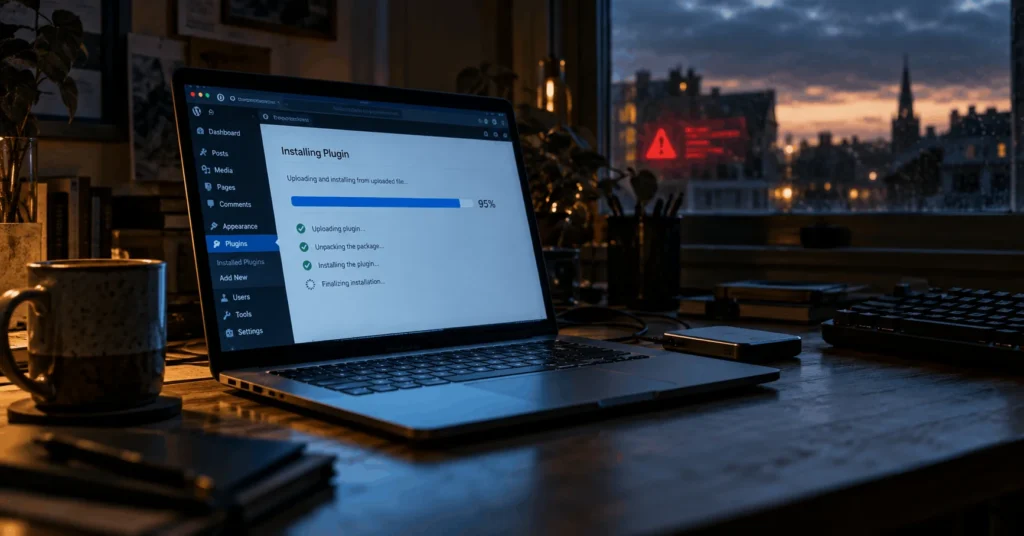
Site owners who paid for a premium WordPress SEO plugin ended up installing malware instead. The Rank Math backdoor shipped inside an official build of Rank Math PRO 3.0.123, pulled straight from the vendor’s own download servers, where it sat for roughly 11 hours. Nothing looked off. Anyone who activated that version during the window now owns a hacked website.
A narrow window with real damage
The poisoned package was live between October 15 at 20:02 UTC and October 16 at 07:12 UTC. Rank Math pulled it once the problem surfaced and shipped a clean release, version 3.0.124. Only the paid PRO edition carried malicious code, so the free Rank Math SEO plugin on WordPress.org, which runs on more than four million sites, came through untouched.
Rank Math has not said how many customers downloaded the bad build, and it has not explained how an attacker reached those files. Scale therefore stays an open question. The Rank Math backdoor only reached premium customers who downloaded inside that 11-hour window. That detail stings.
How the Rank Math backdoor takes hold
Activation is what pulls the trigger, which is why plenty of customers walked away clean. Once someone switched the plugin on, the Rank Math backdoor set up persistent access and started calling an attacker-controlled domain, rank1cdn[.]com. Worse, it rebuilds itself whenever a visitor loads a page. Routine traffic repairs whatever a half-finished cleanup removed, so deactivating the plugin and moving on achieves nothing.
The damage spreads well past the site itself. Everything the web server can read goes to whoever sits on the other end, including database logins, API keys, and secrets for third-party services. A related PHP sample can run commands, rewrite database entries, and steal logins for AWS, Cloudflare, Google Cloud, and Azure. SSH keys go too.
Signs of the Rank Math backdoor on a site
A handful of markers give the infection away, and they are specific enough to search for directly. The first-stage script drops a backdoor at wp-includes/class-wp-cache-util.php. Infected installs also carry a database entry called _np5pvf754c, a cron job tagged #ms6v46, and an XOR key of xmmqhn buried in the code.
Rogue admin accounts are the easiest sign to catch, because they show up in the dashboard like any other user. Attackers created theirs with the wpsupport_ username prefix and @wp-mail.net addresses. Any match there means a full cleanup.
Why an update does not fix anything
Updating to 3.0.124 cleans the plugin and leaves the Rank Math backdoor exactly where it is. The vendor states this plainly. Deactivating or upgrading after a compromise does nothing to the implants. Site owners holding a clean backup from before October 15 have the easier path, since restoring files and database, running a full scan, and rotating every password, API key, and salt will finish the job.
Manual cleanup without a backup gets ugly fast. Delete the entire plugin folder rather than overwriting it, then strip the malicious database entries by hand. After that comes the slow part: hunting for extra backdoors, rogue admin accounts, altered files, and strange scheduled tasks. Block outbound traffic to rank1cdn[.]com as well, since that domain is how the Rank Math backdoor talks to its operators.
Customers who downloaded the file but never activated it come out of this fine. A little caution still pays off. Delete the package, pull 3.0.124, and scan the site to confirm nothing ran, because five minutes of scanning beats a week of cleanup.
The trust problem behind supply chain attacks
Standard advice tells people to buy software from official sources and stay away from nulled plugins. That advice is still correct, and it also failed completely here. When a vendor’s own download page gets tampered with, nobody downstream can tell a clean file from a hostile one, and published checksums rarely help when the hash comes from the same compromised system.
The Rank Math backdoor fits a pattern visible across other recent cases, from hijacked update servers to poisoned developer tools. Defense therefore shifts toward limiting damage instead of preventing every intrusion. Keep backups offsite, where the web server cannot reach them, limit which keys and passwords live on the server, and put two-factor login on every admin account. None of it is glamorous.
Protecting the admin side of a site
Attackers who steal logins rarely stop at the site they broke into. They test the same logins elsewhere, probe hosting panels, and watch for admin sessions worth hijacking. Managing WordPress from café, airport, or co-working Wi-Fi adds exposure, since a hostile network can see which services you reach and push you toward fake login pages.
A good VPN encrypts that traffic and masks connection details, closing one easier route into a site’s backend. It stops there, though. No VPN blocks a poisoned plugin, and none of them will clean a compromised install. Layers matter more than any single tool.
The layers that held up here were boring ones: isolated backups, minimal stored secrets, strong admin logins. Sites hit by the Rank Math backdoor now face weeks of rebuilding trust in their own setup. An update takes a minute.
Final Thoughts
The Rank Math backdoor reached a limited group of customers, but the method behind it should bother everyone running a website. A plugin from a well-regarded vendor turned hostile for 11 hours. The people caught by it did nothing careless. Fast disclosure and a clean release kept the fallout contained.
Cleanup still lands on site owners, and parts of it are grim. Treat the episode as a prompt rather than someone else’s problem. Check your backups, rotate your keys, and look hard at what a compromised web server could reach, because the next supply chain attack will arrive through a channel you trust just as much.
