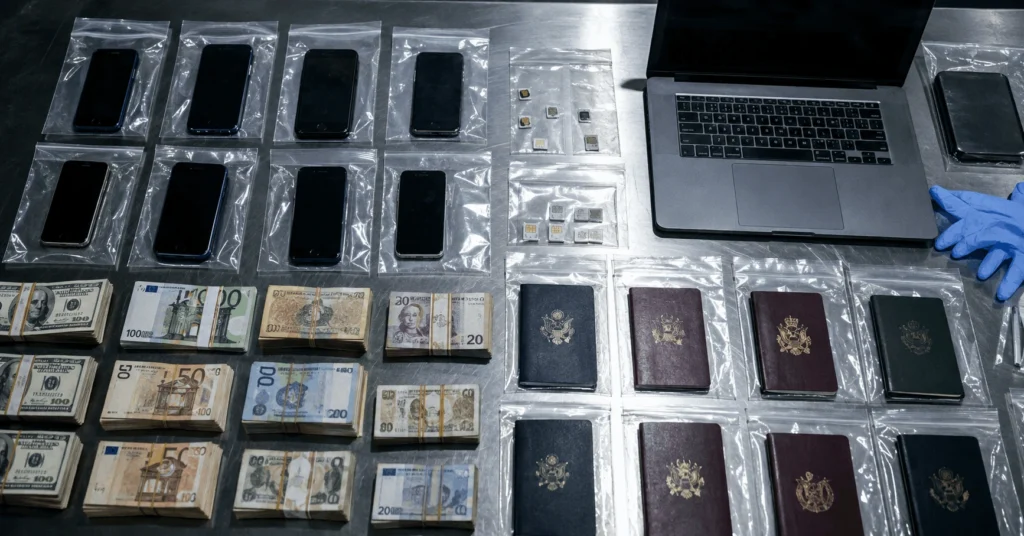
Police forces in 22 countries have closed one of the biggest fraud investigations of the past year. Operation Jackal IV ran from November 2025 through June 2026, and it ended with 58 arrests. Investigators also identified 263 more suspects tied to cybercrime networks run by West African organized crime groups. INTERPOL coordinated the work, and the results open a rare window into how large-scale online fraud really operates.
What Operation Jackal IV targeted
The investigation went after syndicates that treat fraud as a business rather than a hobby. At the center sat Black Axe, a West African group with a long record of cyber-enabled financial crime. Its members run romance scams, fake cryptocurrency schemes, and business email compromise attacks across several continents. Police have also linked the group to violent offenses, so the danger extends well beyond stolen money.
Operation Jackal IV pulled in agencies from every region where these networks operate. That reach mattered, because the money rarely stays in one country. Victims may sit in Canada or Australia while the accounts collecting their savings sit somewhere else entirely.
Where Operation Jackal IV made its arrests
Argentinian officers made 17 arrests and connected 196 suspects to a Crime-as-a-Service network. That network supplied West African groups with web domains and money-laundering support, so it worked as a shared back office for fraud.
South African authorities arrested 39 people, blocked 257 bank accounts, and seized $2.67 million. The syndicate behind those accounts went after retirees in English-speaking countries. Investment offers and romance scams served as the bait.
Romanian police detained 11 more suspects. That group ran a call center that promised huge returns on stocks and cryptocurrency, and then walked victims through a scripted investment scam. Italian investigators identified one suspect linked to a pan-European laundering operation. Money moved through shell companies, remittance services, and plain cash withdrawals.
Crime-as-a-Service keeps the machine running
One detail from Operation Jackal IV deserves close attention. Several syndicates bought services from outside providers instead of building everything themselves. INTERPOL said some groups procured Crime-as-a-Service from external suppliers, often through the dark web, to outsource money laundering and other critical operations.
That model explains the scale. A scam crew no longer needs technical skill, banking contacts, or hosting expertise, because it can rent all of it. So arrests remove the people who send the messages, but the supply chain survives. A new crew can rent the same infrastructure next month.
Who these networks target
The victim profile in Operation Jackal IV followed a familiar pattern. Fraud groups pick people who are easy to reach and slow to report. Retirees, lonely users, and small business finance staff all fit that description. INTERPOL also flagged sextortion as part of the wider problem, since offenders contact minors on social media, build trust, and then demand payment under threat of exposure.
Most of these schemes begin with research. Attackers collect names, photos, workplaces, and relationship status from public profiles, and then they tailor the approach. The message feels personal because the criminal did homework first.
Part of a wider enforcement push
Operation Jackal IV follows a run of similar actions. Between December 8 and January 30, police across 16 African countries arrested 651 suspects in Operation Red Card 2.0. Then in July, INTERPOL announced 5,811 arrests and $293 million in seized assets from Operation First Light 2026. That effort involved investigators from 97 countries.
Those numbers look impressive, but the pattern repeats every few months. Enforcement removes operators from the field. However, the underlying market rebuilds fast, because demand for scam infrastructure never drops.
What everyday users can do
The arrests in Operation Jackal IV will not stop the next wave of messages. Scams begin with contact, so cutting your exposure helps. Review your privacy settings on social platforms, and lock down anything a stranger could use to build rapport. Also treat unsolicited investment advice as a red flag, especially when it arrives through a dating app.
A VPN will not stop someone from lying to you online. Still, it trims the trail you leave behind. It hides your IP address and rough location from the sites you visit, and it encrypts your traffic on public Wi-Fi. Fraud rings trade data that helps them profile targets, so broadcasting less makes you a harder mark.
Financial habits matter just as much. Never move money because a new online contact asks you to. Verify payment changes by phone, using a number you already had on file. If a platform blocks withdrawals or demands extra fees before releasing funds, walk away and report it.
Final Thoughts
Operation Jackal IV delivered real results. The 58 arrests, the frozen accounts, and the millions in seized cash all disrupt active criminal groups. Yet the case also exposes how industrial online fraud has become.
Criminals now buy laundering, hosting, and domains the same way legitimate firms buy cloud services. Police can dismantle one network, but the marketplace serving it keeps trading. So the practical defense still sits with users. Guard your personal data, question urgency, and slow down whenever money enters an online conversation.
