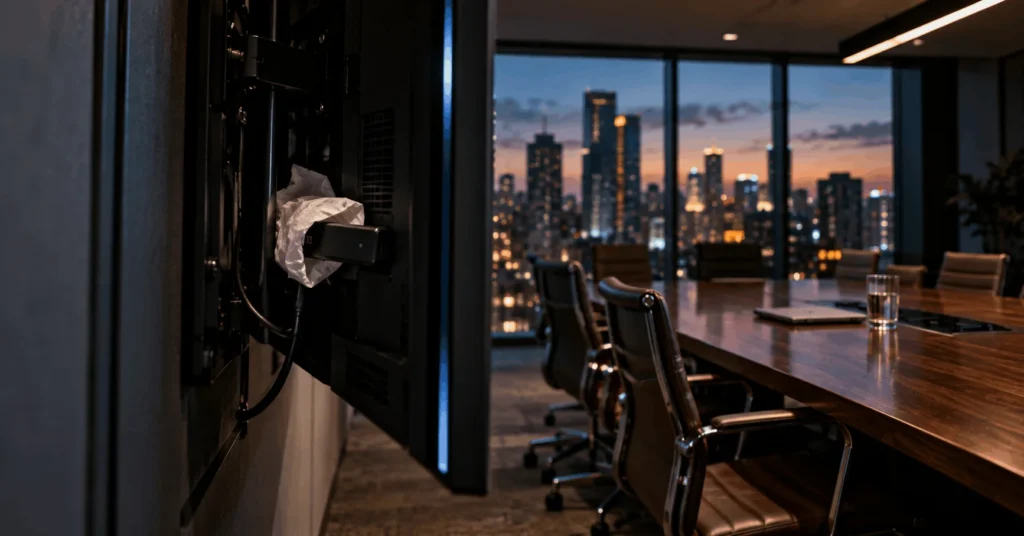
Federal prosecutors say a software engineer hid a microphone inside OpenAI’s San Francisco offices. Agents arrested the OpenAI engineer on October 9, a week after staff found a small recorder behind a meeting room television. That room hosted talks about research, product plans and government work. He then went back to check on the device, with no idea that the company had already pulled it out.
The OpenAI engineer arrested in this case is Abdulrahman Alfozan, 35, a Saudi national who joined the firm in July 2025. He faces one charge of illegally intercepting oral communications. That count carries up to five years in prison and a $250,000 fine. A court has yet to test any of the claims against him.
A recorder hidden behind a television screen
Security staff found the first recorder on September 30, tucked behind a screen in an executive meeting room. It drew power straight from the television’s USB port. Someone had wrapped it in toilet paper to keep it out of sight. The trick sounds crude, but it worked well enough for a couple of days.
Encryption locked the data, so nobody could read the contents on the spot. Agents believe the device went in around September 28, two days before the find. The room itself mattered far more than the cheap hardware did. Teams used it for talks about secret research, product plans, business deals and government work.
Anyone listening in would have picked up material worth real money to rivals. Foreign spy agencies would want it just as badly. So the discovery set off a full internal hunt rather than a quiet cleanup. Agents arrested the OpenAI engineer blamed for the device nine days later.
Why agents arrested an OpenAI engineer days later
Camera footage placed the suspect near that meeting room again and again. His job gave him no reason to sit in on anything held there. Prosecutors say he also used an internal work tool to look up office layouts, room details and schedules. Those searches helped build the case against the OpenAI engineer arrested in October.
A chatbot account tied to his wife turned up next in the complaint. Someone used it to ask how to build and hide a listening device. The questions covered nonstop audio capture, Wi-Fi tweaks, better live listening and SD card encryption. Between September 27 and 28, that same account asked about the exact device, down to its custom header and MAC address.
On October 5, cameras caught the man walking back in and peering behind the television. Staff then searched a bag he had left alone in another room. Inside sat a second recorder, almost the same as the first. Agents arrested the OpenAI engineer four days later, and the company fired him and called in the FBI.
AI used to catch a bug allegedly built with AI
OpenAI says it pointed its own models at the hardware to work out what it was. The models helped trace where the device came from and who had put it there. That work led the security team to one employee within days. So far, reviewers found no sign that the arrested OpenAI engineer touched model weights, source code or customer data.
An AI lab used its own models to unmask an alleged spy inside its own building. That spy, prosecutors say, leaned on a chatbot to put the bug together. The OpenAI engineer arrested this month allegedly asked a public chatbot what once took an expert. That symmetry is hard to miss, and the lesson travels well beyond one company.
Why the OpenAI engineer arrested in San Francisco matters for privacy
Most privacy advice deals with data while it moves across a network. Encryption shields your traffic, and a VPN hides your browsing from the network operator or anyone watching public Wi-Fi. Password managers guard your logins. But a microphone behind a screen skips all of it, because it grabs words before they ever become data.
That gap gets far less attention than it deserves. Room sweeps, visitor logs, port locks on shared screens and tight rules on who gets in belong in the same plan as endpoint defense. Smaller firms rarely budget for any of it, yet they hold client contracts and product plans worth stealing. The OpenAI engineer arrested in San Francisco allegedly needed only access, patience and a cheap recorder.
Practical steps that actually work
Treat meeting rooms as attack surfaces and check the USB ports on screens and video systems. Limit badge access to rooms where leaders meet, then review footage on a schedule instead of only after trouble. For remote and hybrid staff, pair a solid VPN with encrypted messaging so sensitive calls stay safe on untrusted networks. None of this stops a determined insider outright, though it shrinks the window they get.
Final Thoughts
Insider cases rattle firms in a way that outside breaches rarely do. They break an assumption rather than a firewall. The OpenAI engineer arrested on October 9 held a real badge, real credentials and a real reason to walk the halls. Prosecutors will argue that he used all three to listen in on talks he was never invited to.
For everyone else, the takeaway sits somewhere between the software and the furniture. Strong encryption, a trusted VPN and careful account habits still carry most of the load for personal privacy. They protect what crosses a network, and nothing more. Guarding the rest means looking at the room itself, and sometimes behind the television.
