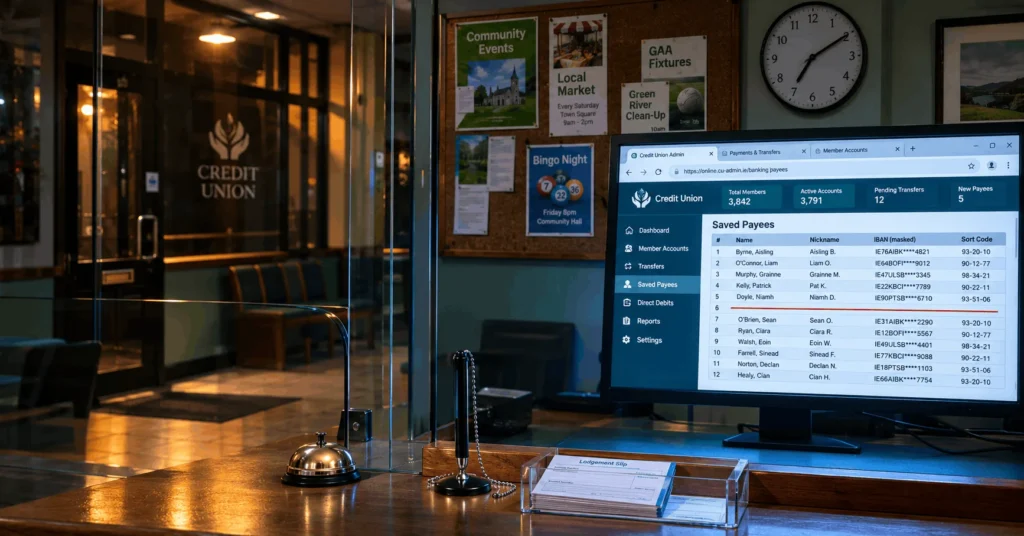
Dozens of community lenders in Ireland spent this week sending members an uncomfortable warning. It came with a hole in the middle. Attackers reached a supplier they all depend on in early October. Saved payment details may have moved, and nobody can say who was affected. The data breach at Irish credit unions touched about 40 of them, and the number of members involved is still unknown. That gap is the real problem.
Many Irish credit unions are small-town lenders where the staff behind the counter are familiar faces. So trust runs deeper there than at a big bank. That is part of why this stings, because the leak came through a supplier most members had never heard of. Six Irish credit unions have confirmed impact from the data breach so far: Capital, Phoenix, St. Canice’s, First South, Malahide, and Limerick and District. More names may follow.
What the data breach at Irish credit unions exposed
The stolen records sit in a corner of online banking that people set up once and forget. Saved payee details hold the name on the account, any nickname you gave it, the IBAN and BIC, the account number and sort code, address lines, and any reference text attached to the payments you have sent. Passwords, PINs, card numbers and banking logins stayed out of reach, so account takeover is not the main worry. The records also show which member saved which payee, so a plain list of bank details turns into a map of who pays whom.
Five million requests in three days
This attack ran between 2 and 4 October, and it leaned on volume instead of stealth. An automated script fired roughly five million requests at an authorization flaw in the supplier’s systems. It carried valid logins, so each request looked normal. Flaws of this kind show up when a system checks that you are signed in but not that the data is yours. Change one number in a request, and the server hands back a stranger’s file. Repeat that five million times and you have the scale of the data breach now facing Irish credit unions.
No logs, no answers
Wellington IT is the Belfast firm at the centre of this. It says it does not hold the activity logs that would show what the script pulled. That one absence explains a lot. The Irish credit unions handling this data breach cannot tell members what happened to their own records. Without logs, there is no way to rebuild which queries worked or which payees came back in the results. So every member with saved payees has to assume the worst.
Six weeks of silence
The attack happened in early October, and the letters reached credit unions in mid-November. Politicians in Ireland have criticised that delay. Minister of State Robert Troy, who confirmed Wellington IT as the supplier involved, called it “not acceptable”. Six weeks is plenty of time to put fresh payee data to work. Members of the Irish credit unions caught in this data breach had no reason to watch their accounts during the weeks when it mattered most.
One supplier, dozens of lenders
Wellington IT serves a large share of Ireland’s credit union sector, which is why one flaw reached so many lenders at once. Credit unions run on small IT budgets, so sharing a platform makes plain financial sense. The bill lands on a day like this. Security at 40 separate lenders turned out to rest on one firm’s code. The data breach at Irish credit unions has made that reliance plain, and members never saw the contract behind their online banking anyway.
Steps worth taking now
Anyone banking with one of the Irish credit unions hit by this data breach should be slow to trust surprise contact about payments. Fraudsters holding those records also know who you pay. They can quote a believable reference and ask you to update the account details before the next transfer. No credit union asks for login codes, PINs or password resets by phone or email. Any message of that shape can go straight in the bin, no matter how urgent it sounds.
Checking a payment change is worth the two minutes it costs. Call the credit union on a number you looked up yourself, not one printed in the message. That one habit removes most of the attacker’s advantage. The data breach at Irish credit unions gives everyone banking with one of them a reason to make that check routine.
Wider habits that help
Good account hygiene matters well beyond this one incident, and most of it costs nothing. Unique passwords, a password manager and two-step login on banking and email shrink what a successful phish can achieve. A good VPN encrypts your connection on public Wi-Fi, which keeps session data away from anyone else on the network. It will not stop you typing details into a fake, though. The habit that helps most is simple: pause before you act on money requests that arrive out of the blue.
Final Thoughts
Irish credit unions dealing with this data breach are in an awkward spot. They must also warn members about a risk nobody can size. No group has claimed the attack, no count of affected people exists, and the missing logs mean a solid number may never arrive. Members should treat saved payee details as public for the time being. For the sector, the lesson sits in the logging, because defences failed here, and the blind spot that followed turned a small incident into an open question.
