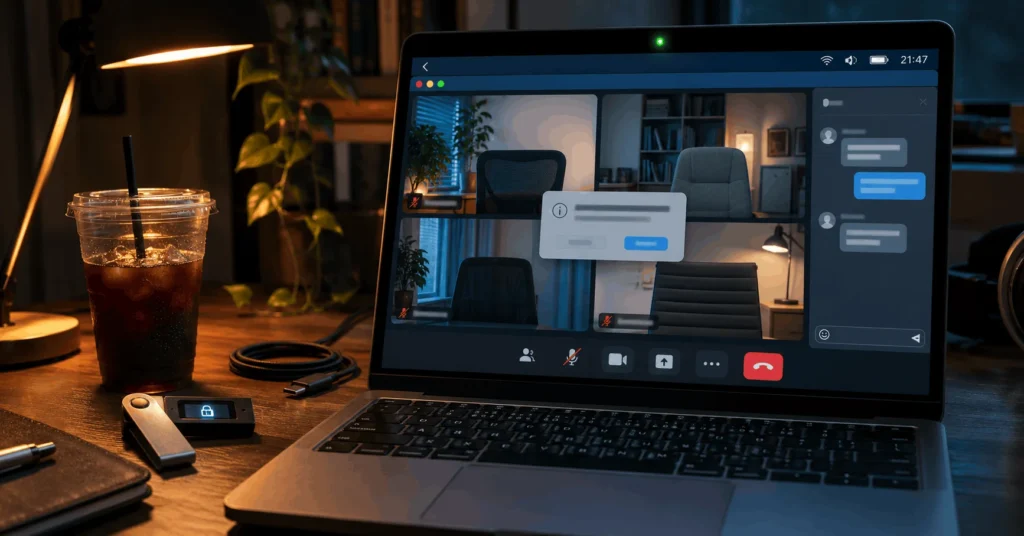
A North Korean crypto theft ring has just lost the servers it ran on. On November 12, US agents seized the cloud setup behind the FaceStealer campaign, ending an 18-month run that drained more than $400 million. They also recovered over 900 webcam videos. Each clip was secretly taken from a tech worker who had no idea. Those recordings were the whole point, because they let a stranger borrow a face that people already trusted.
How the FaceStealer campaign borrowed real faces
The break-in always came first, and the money followed much later on. Attackers took over a victim’s account on Slack, Telegram, Discord, or LinkedIn. From there they messaged that person’s contacts and invited them to a video call, which arrived under a name the target already knew. That one detail did most of the work. Nobody questions a meeting request from a colleague.
The meeting link looked like Zoom or Microsoft Teams, but it led to a fake site. That site was built to pass a quick glance. Once the target joined, operators played recorded webcam clips of real colleagues. Sometimes they padded the call with extra fake guests. The faces moved, the rooms looked plain, and nothing in the call felt out of place for anyone watching. Then one of them said they could not hear the target.
Everything in the call built toward one moment, which was the offer to fix the problem. Operators sent an update link, a script, or a line to paste into a terminal. Running it installed malware. That code could grab browser cookies, log keystrokes, take screenshots, and keep a quiet door open for later. Researchers call the trick ClickFix. The FaceStealer campaign used it throughout, though the FBI never applied that label in its alert.
Why the FaceStealer campaign hunted open-source developers
Crypto holders were the obvious prize, but the net went wider than wallets. The FaceStealer campaign also went after open-source maintainers. One compromised maintainer opens a path into every project that leans on their code, and that is a lot of leverage for a single break-in. In one case the crew reached the maintainer of a heavily used JavaScript library and tried to slip bad code into the project, though defenders caught it before it spread downstream.
That wider reach changes who should care about this case and why. Supply-chain access can touch thousands of firms that never held a single coin, and most of them would never see it coming. Maintainers often work alone, review code from strangers, and take calls from contributors they have never met. Those habits are normal, and they are also a gap.
Patience as a weapon
Most theft stories end with a fast drain, so this one reads oddly. Operators behind the FaceStealer campaign sat on their access for months, and in several cases for well over a year. They watched wallet balances and picked their moment. Meanwhile they harvested contacts, social accounts, and chat logs. A single break-in therefore kept paying out long after the video call had ended.
A second front worth $1.2 billion
The FaceStealer campaign was not the only North Korean case moving that week. On or about October 29, a military unit the FBI calls TraderTraitor stole more than $6 billion in virtual assets from Binance, which stands as the largest crypto heist on record. Public and private efforts have frozen $2.7 billion. A court order now lets the Justice Department seize or hold more than $1.2 billion. Laundering goes on through bridges, mixers, and exchanges, so the FBI asked virtual asset firms to block the addresses in play.
Practical defenses after the takedown
Seizing servers slows a crew down, yet it rarely stops one. The group behind the FaceStealer campaign has rebuilt before under names like Sapphire Sleet, BlueNoroff, APT38, and UNC1069. Expect the same playbook on new servers within months. The FBI posted an alert through IC3 and a hub at fbi.gov/facestealer for anyone who thinks they were hit.
A few plain habits close most of the gap this crew walked through. Check a meeting link through a second channel first. Type the platform address yourself rather than tapping what someone sent. Never paste a command into a terminal because a voice on a call told you to, since no real support team works that way. Two-factor logins on chat apps matter most, because the FaceStealer campaign always began with a hijacked account.
Network hygiene plays a smaller part here, and it is worth saying plainly. A VPN will not stop malware you install yourself. It does cut your exposure on open networks and hides your traffic from anyone watching it. That matters if you work from cafes and shared desks. Pair it with a hardware key and a habit of checking people, and the odds shift.
Final Thoughts
The takedown cost the crew its servers, 900 recordings, and a lot of quiet. Still, the FaceStealer campaign worked by borrowing real trust rather than faking urgency, and that trust sits there untouched, waiting for the next crew willing to try the same approach. Video calls now carry the checking burden that email picked up a decade ago. Assume the face on screen needs a second look, and the best part of this trick stops working.
