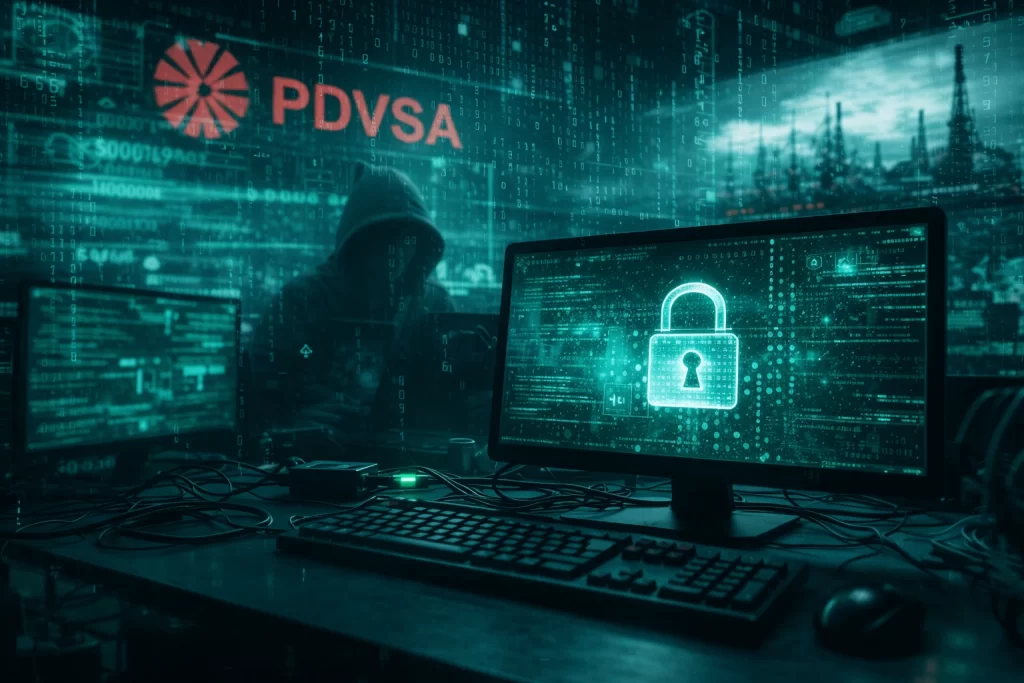
A PDVSA cyberattack disrupted internal systems at Venezuela’s state-owned oil company, creating uncertainty across export coordination and administrative operations. The incident came to light over the weekend after employees lost access to digital platforms used to manage shipments, documentation, and payments linked to oil exports.
PDVSA confirmed the attack and said it activated contingency protocols designed to protect production and exports. Company officials insisted that oil extraction and refining continued without interruption, emphasizing that the disruption affected administrative systems rather than industrial controls. Even so, multiple industry sources suggested the operational impact was more significant than officials initially acknowledged.
As systems went offline, staff were instructed to disconnect affected networks and switch to manual workflows. That transition allowed limited continuity but immediately slowed approvals, complicated coordination with international buyers, and increased pressure on export terminals already operating under tight timelines.
Export and Administrative Systems Taken Offline
The cyberattack targeted platforms supporting export logistics, invoicing, and cargo scheduling, according to sources familiar with the response. Security teams isolated affected environments to prevent further spread, a move that reduced immediate risk but restricted PDVSA’s ability to process shipments efficiently.
With digital tools unavailable, employees relied on paper documentation and offline records. Several tankers reportedly remained idle longer than planned as clearance procedures stalled. Manual processing also increased the likelihood of delays and errors, particularly as paperwork accumulated across multiple terminals.
Even short disruptions had outsized effects, given PDVSA’s dependence on centralized systems to manage high-volume export flows.
Conflicting Accounts Over Operational Impact
PDVSA maintained that exports continued under emergency protocols and denied any meaningful disruption to oil flows. Officials framed the incident as an administrative setback rather than a threat to production or delivery.
Sources involved in export operations offered a more cautious assessment. They described paused shipments, delayed loadings, and reduced activity while teams worked through offline procedures. Some cargo movements reportedly resumed only after partial system restoration and manual verification.
The contrasting accounts reflect the challenges of managing transparency during cyber incidents, particularly in politically sensitive sectors like energy.
Political Accusations and Unclear Attribution
Venezuelan authorities quickly blamed foreign actors for the PDVSA cyberattack, publicly accusing the United States and alleged internal collaborators. No technical evidence has been released to support those claims.
Cybersecurity experts have not linked the incident to any known threat group, and no ransomware actors have claimed responsibility. Investigations remain ongoing as analysts assess access methods, scope, and potential motives.
Why the PDVSA Cyberattack Matters
PDVSA plays a central role in Venezuela’s economy and global oil supply chains. Disruptions to its systems carry economic and geopolitical implications well beyond the country’s borders.
The incident highlights how attacks on administrative platforms can still disrupt physical operations, even without targeting industrial control systems. Export delays, documentation failures, and coordination breakdowns can quickly ripple across energy markets.
Final Thoughts
The PDVSA cyberattack illustrates how digital disruptions can translate into real-world operational risk for critical energy infrastructure. Even limited outages forced inefficient manual workarounds and slowed export activity.
As investigations continue, the incident reinforces the need for stronger cyber resilience across state-owned energy firms, where administrative systems now represent a core operational dependency rather than a back-office concern.
