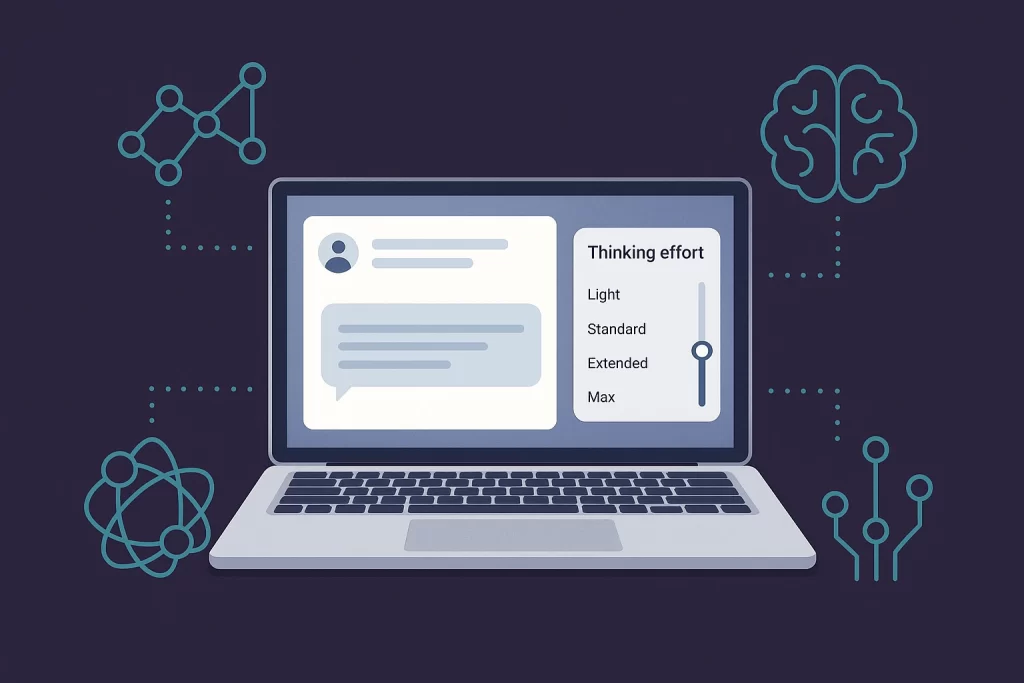
OpenAI has introduced the new Thinking Effort ChatGPT feature, a tool that gives users more control over how the model reasons before answering. Instead of relying on a one-size-fits-all response, people can now adjust the level of reasoning to match the complexity of their request. This feature highlights OpenAI’s effort to improve transparency while offering personalization in AI interactions.
What Is the Thinking Effort ChatGPT Feature?
The Thinking Effort setting allows users to decide how much processing power ChatGPT applies when generating answers. It introduces four effort levels, each designed for a specific type of task:
- Light – quick answers with minimal computation.
- Standard – balanced replies for general tasks.
- Extended – in-depth analysis with more processing time.
- Max – the most advanced reasoning, available only to Pro subscribers.
Each level controls the model’s internal “juice value,” which determines how many reasoning steps it takes before producing a response.
Why It Matters
This feature moves control away from hidden AI processes and places it directly in the user’s hands. A student may prefer Light for fast notes, while a researcher could select Extended for deeper context. Businesses or professionals handling complex issues might rely on Max for maximum reasoning depth.
The Max setting, however, requires a costly Pro subscription. This decision underlines OpenAI’s balance between accessibility and business strategy. It also raises questions about how much advanced reasoning should remain paywalled in future AI tools.
Potential Use Cases
The flexibility of the Thinking Effort ChatGPT feature creates broad possibilities:
- Education – Light helps with quick study guides, while Extended offers richer explanations.
- Research – Complex analysis benefits from higher levels that explore topics more deeply.
- Business – Companies can use Max for strategic planning, market research, or technical problem-solving.
- Creative Work – Writers and designers might switch between Standard and Extended depending on brainstorming or polishing needs.
From quick summaries to deep dives, the feature adapts to any workflow.
Industry Impact
This update signals a larger shift in AI design. Instead of only improving models behind the scenes, developers now give users visible tools to guide reasoning. By doing so, OpenAI demonstrates how computation can translate into quality differences. Rival companies may soon follow with similar effort controls, reshaping expectations for customizable AI performance.
Final Thoughts
The Thinking Effort ChatGPT feature represents a meaningful step toward user-directed AI. By offering four reasoning levels, OpenAI gives people a way to balance speed, accuracy, and depth based on their needs. While the Pro-only Max option limits full access, the overall design empowers all users to shape their AI experience. This control over reasoning marks the beginning of more transparent, customizable AI interactions.
